With the construction of the new refractory warehouse, Breitenfeld Edelstahl AG is setting another milestone towards increasing efficiency, modern warehouse logistics and sustainable resource planning.
The facility, which will go into operation in 2025, combines high-bay technology, emission-free forklift logistics and sophisticated material flow concepts.
Dr. Martin Stückelschweiger, Head of Refractories, Infrastructure and Secondary Raw Materials, explains the technical background and strategic importance of the new building.
1. interlinked areas of responsibility as the basis for efficiency
Dr. Stückelschweiger is responsible for three central areas that are more closely interlinked in day-to-day production than they appear at first glance.
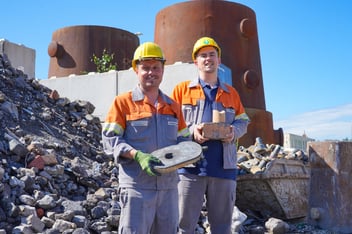
Refractory materials ensure the operation of the melting units, while the secondary raw materials department processes used materials and returns them to the material cycle. The infrastructure in turn forms the organizational and structural foundation for smooth processes.
This interlinking also characterizes his approach to the task: a holistic, systemic understanding instead of isolated considerations. The aim is to develop sustainable solutions that are viable in the long term, both technically and ecologically.
2 Strategic background of the new building
The construction of the new refractory warehouse was a logical consequence of the company's growth and the increasing variety of refractory materials. The increasing demands on capacity, purity and logistical efficiency required a new solution.
"With the growth of the company and the large number of new material types, the new building was unavoidable," emphasizes Dr. Stückelschweiger.
3. technical equipment of the high-bay warehouse
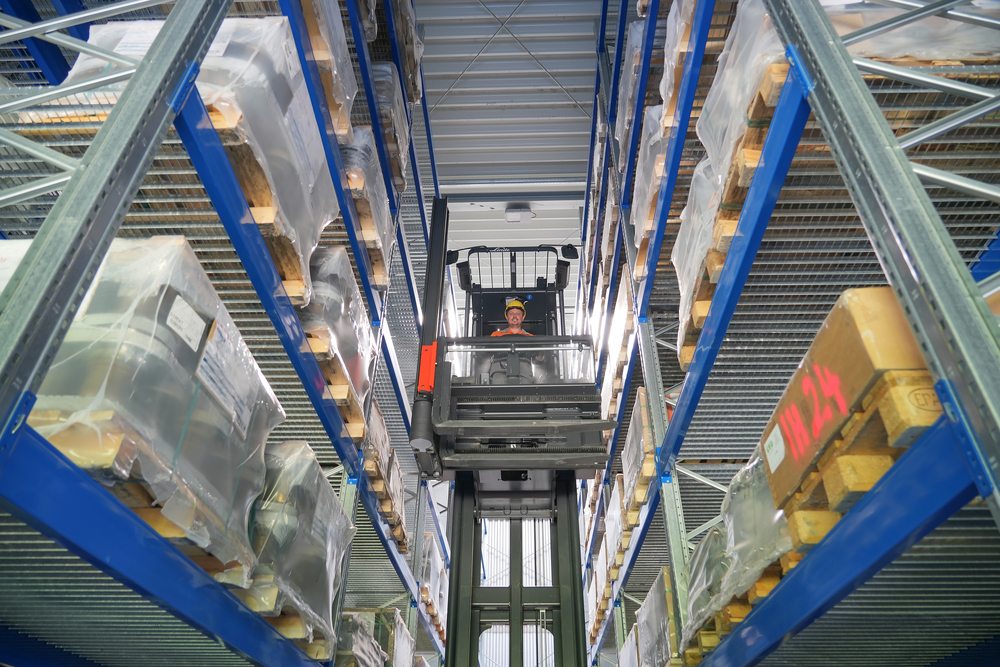
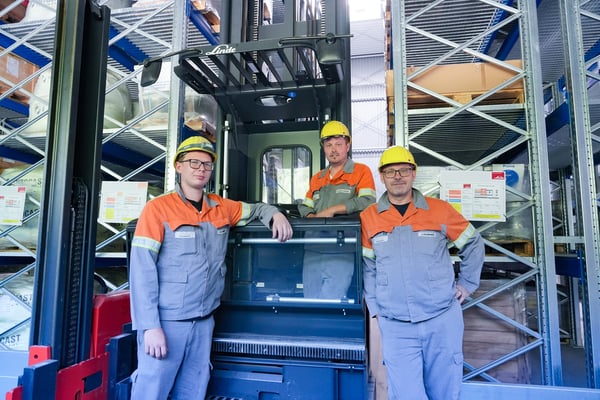
The new warehouse is an ultra-modern high-bay system with significant differences to the previous storage system. Around 1,000 pallet spaces were created on just 300 m² - a leap in efficiency made possible by vertical use and the use of a sensor-controlled electric forklift.
Key features:
- High-bay racking with a storage height of 9 m
- Rack aisle width of just 1.8 m
- Emission-free electric forklift with autonomous steering function
- Compact footprint with maximum capacity
These technical solutions not only increase storage capacity, but also enable precise, safe and redundancy-free material logistics.
4. importance for production safety and material supply
The new warehouse significantly improves processes in day-to-day production. Clear structures, rapid material availability and transparent stocks reduce search times and prevent supply bottlenecks.
At the same time, forward planning is made possible, which is a key factor for the stability of steel production.
"Thanks to the clear structure, we know immediately which materials are available. This prevents bottlenecks and significantly increases security of supply," says Dr. Stückelschweiger.
5 Sustainability and resource efficiency
The new warehouse also sets new standards in terms of sustainability. The electrically powered forklift technology ensures emission-free warehouse logistics. At the same time, the warehouse is closely linked to the company-wide circular economy: refractory materials are increasingly collected by type, processed and reintroduced into material cycles.
This approach reduces transportation routes, conserves primary raw materials and strengthens operational autonomy in the supply of materials. Evidence of this can be found in several of the interview responses, which show the direct link between warehouse logistics and a sustainable secondary raw materials strategy.
6 Improved work processes and relief for the team
The new building also has a positive impact on work organization. The proximity of the materials to the place of use significantly reduces internal transportation routes. Process-oriented storage and clear structuring increase work safety and efficiency.
"The materials are available right next to the workplace - this reduces internal transport to a minimum," explains Dr. Stückelschweiger.
Training is also a central component of this area: new materials sometimes require new processing methods, and in the secondary raw materials sector, new sales opportunities are creating additional requirements for sorting and processing.
7 Infrastructure as the foundation of future-oriented production
In his concluding message, Dr. Stückelschweiger emphasized the importance of modern infrastructure:
"Modern infrastructure is far more than just buildings or facilities - it is the basis for innovation, safety and sustainability. Investing in solid structures today creates the basis for tomorrow's success."
The construction of the new refractory warehouse illustrates this claim. It is a project that goes beyond pure logistics: it strengthens security of supply, increases efficiency and supports the sustainable orientation of the entire group of companies.
8. conclusion
With the new refractory warehouse, Breitenfeld Edelstahl AG is setting an example of modern, resource-conserving and technology-driven warehouse organization.
The new building shows how technical innovation, sustainability strategies and process-oriented infrastructure can form a high-performance unit.
The combination of a vertical storage solution, emission-free forklift technology and clearly structured material flows offers long-term benefits for production, employees and the environment.